Blog & Articles
French Press vs Pour-Over Brewing Guide

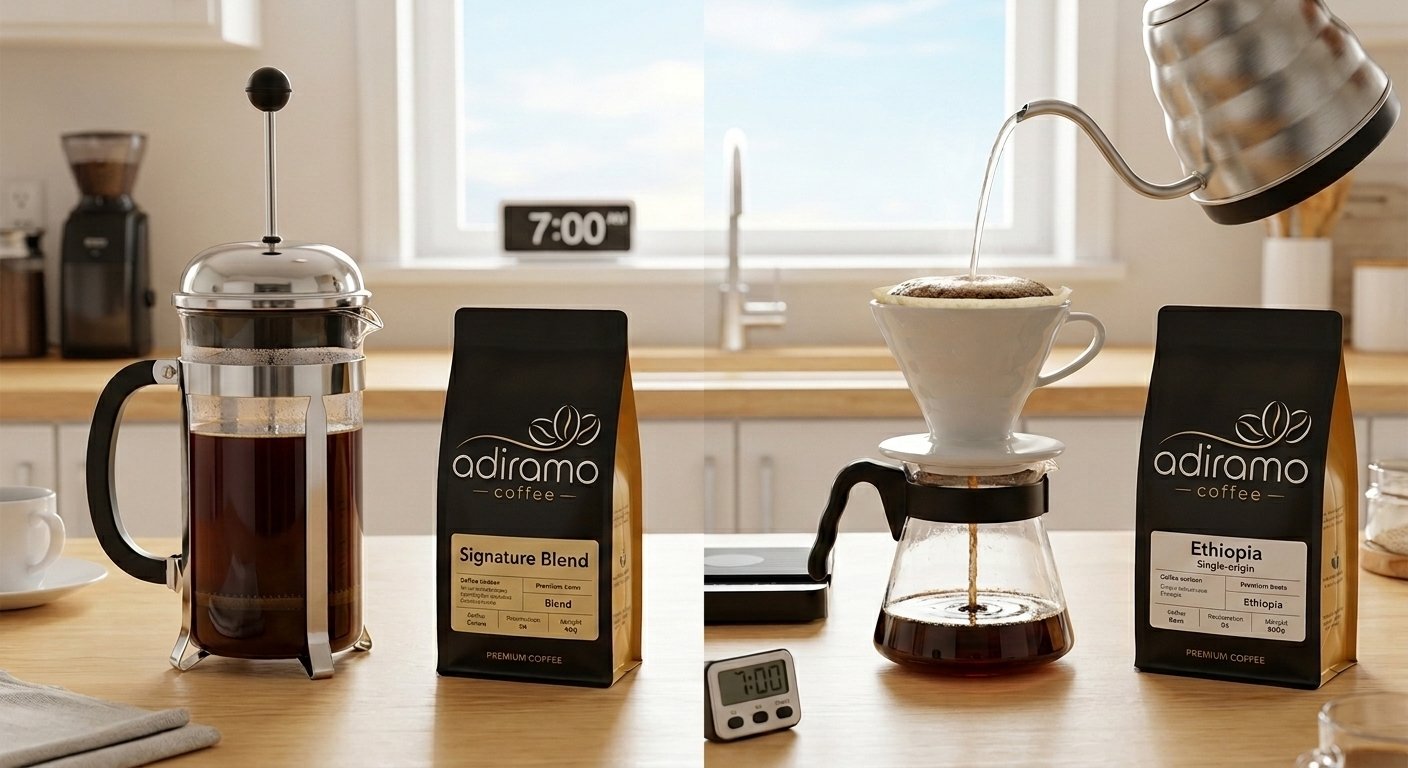
French Press and Pour-Over extract coffee using fundamentally different methods: full immersion versus drip percolation. Immersion extracts soluble compounds uniformly over 4 minutes, yielding a heavy-bodied cup with natural coffee oils. Percolation washes hot water through a bed of grounds and a paper filter, producing a clean cup with bright acidity and distinct flavor notes. Choosing between them depends on your preferred body, clarity, and routine.
1. Core Parameter Comparison
Using medium or light-medium single-origin beans like Adiramo Single-Origin Guatemala highlights the structural differences between these two brewing styles.
| Parameter | French Press (Immersion) | Pour-Over (Percolation) |
| Brew Ratio | 1:15 (e.g., 30 g coffee to 450 g water) | 1:16 (e.g., 25 g coffee to 400 g water) |
| Grind Size | Coarse (resembles kosher salt) | Medium-Fine (resembles table salt) |
| Filter Type | Metal Mesh | Paper or Cloth |
| Brewing Time | 4:00 minutes | 2:30–3:30 minutes |
| Body & Texture | Full-bodied, heavy, rich in oils | Light to medium body, clean |
| Flavor Profile | Earthy, deep, low acidity | Vibrant, articulated, high clarity |
| Technique Difficulty | Low (entry-level consistency) | Moderate to High (requires pouring control) |
2. French Press: Step-by-Step Brewing Protocol
The French Press relies on time, temperature, and grind size to control extraction without requiring precise pouring technique. Freshly roasted dark or medium-dark roasts, such as Adiramo Signature Roast, excel in this method.
1.Preheat and Add Coarse Grounds:Match grind size to mesh filter density.
Rinse your French Press carafe with boiling water to warm the glass, then discard the rinse water. Add 30 g of coarse-ground coffee into the chamber.
2.Pour Water & Saturate:Saturate all grounds evenly within 30 seconds.
Pour 450 g of water at 93°C (200°F) directly over the coffee bed, ensuring all grounds are saturated. Attach the lid with the plunger pulled all the way up to trap heat.
3.Break the Crust at 4:00:Form a flat coffee bed for clean plunging.
At the 4-minute mark, remove the lid and use a spoon to gently stir the top crust. Most grounds will sink to the bottom. Skim off remaining surface foam and floating micro-grounds.
4.Press Slowly and Decant Immediately:Avoid forcing grounds through the mesh.
Reinsert the plunger and push down with steady, gentle pressure over 15 to 20 seconds. Decant the coffee into cups immediately to prevent over-extraction in the carafe.
3. Pour-Over: Step-by-Step Brewing Protocol
Pour-Over extraction relies on flow rate and pour mechanics to control how water extracts solubles from the coffee bed.
1.Rinse Paper Filter & Charge Grounds:Eliminate papery taste and preheat the brewer.
Place a paper filter in your dripper (V60, Chemex, or Kalita Wave) and rinse thoroughly with hot water. Drain the water, then add 25 g of medium-fine ground coffee. Tap the dripper to level the bed.
2.Execute the Bloom Pour:Release trapped carbon dioxide from fresh beans.
Start your timer and pour 75 g of water (3x the coffee weight) in concentric circles. Allow the coffee bed to expand and bloom for 45 seconds.
3.Main Pour Cycles:Maintain a consistent water height and flow rate.
Pour water in gentle spiral patterns from the center outward, avoiding the filter walls. Add water in two stages (up to 250 g, then up to 400 g total weight), finishing all pouring by 2:15.
4.Final Drawdown & Serve:Ensure uniform drawdown through the grounds.
Give the dripper a gentle swirl to wash down grounds adhering to the filter sides. Let the water drain completely through the bed by 3:00 to 3:30. Discard filter and serve.
4. Flavor Diagnostics & Decision Matrix
Choose French Press If:
- You prefer heavy, bold coffee with maximum mouthfeel and zero paper filter absorption of oils.
- You need to brew multiple servings (3–4 cups) simultaneously without monitoring water flow.
- You use medium to dark roasted coffee profiles that thrive on high body and sweetness.
Choose Pour-Over If:
- You drink delicate single-origin light roasts with floral, fruity, or tea-like flavor notes.
- You prefer zero sediment at the bottom of your cup.
- You enjoy the interactive, ritualistic process of controlling water flow with a gooseneck kettle.
5. Frequently Asked Questions
Why does my French Press taste muddy?
Muddy texture stems from fine coffee particles passing through the metal mesh filter. Grind coarser, use a high-quality burr grinder to minimize fines, and skim the surface crust before plunging.
Can I use the same grind size for both methods?
No. Using a French Press coarse grind in a pour-over dripper causes water to pass through too quickly, producing weak, under-extracted coffee. Using a pour-over fine grind in a French Press clogs the mesh filter and causes severe over-extraction.
Which brewing method extracts more caffeine?
French Press generally extracts more caffeine per volume due to longer total contact time (4 minutes of full immersion versus dynamic flow extraction).